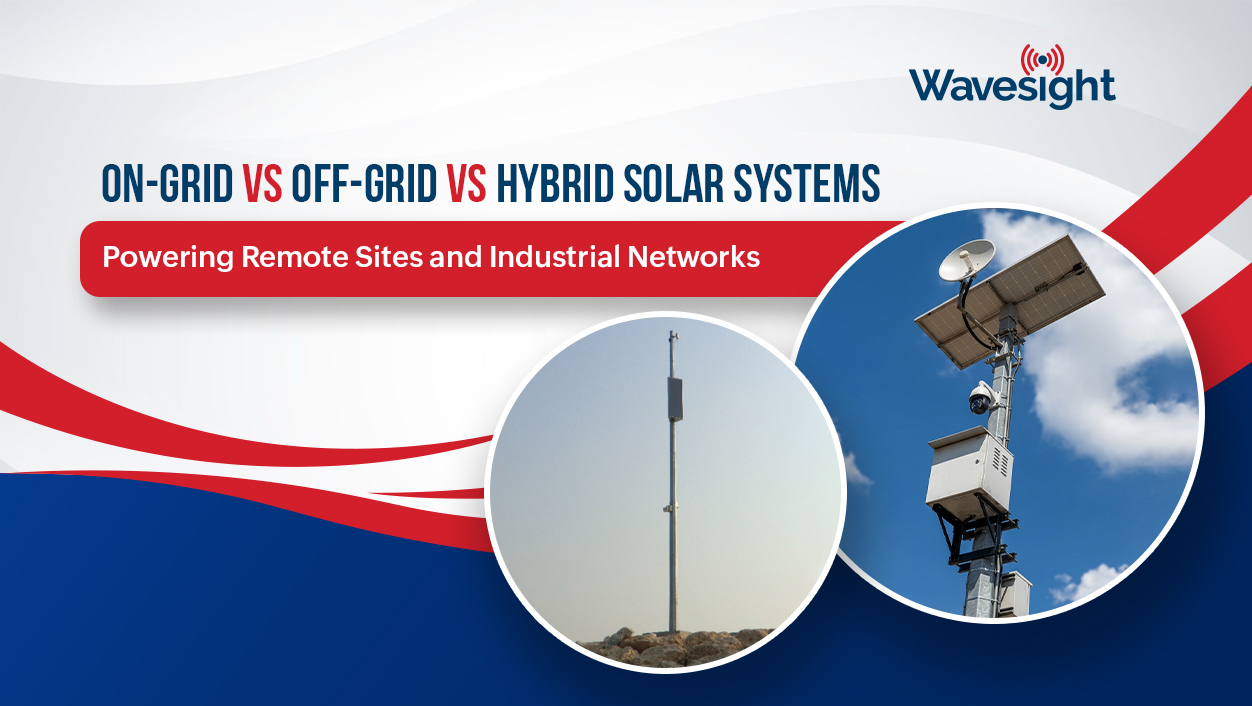
On-Grid vs Off-Grid vs Hybrid Solar Systems: Powering Remote Sites and Industrial Networks
In industries like mining, offshore and onshore wind farms, highways, rail corridors, and remote industrial sites, operations often rely on equipment in locations far from reliable grid power. From surveillance cameras and network radios to critical sensors and pumping stations, even a brief power interruption can halt operations, compromise safety, and increase operational costs.
Choosing between on-grid, off-grid, or hybrid solar systems is not just a technical decision, it is a strategic choice that directly impacts uptime, efficiency, and long-term operational reliability. This article examines each approach with practical applications for real-world deployments.
What we will explore in this article
This article explores how on-grid, off-grid and hybrid solar systems support connectivity and operations in remote and industrial environments. You’ll gain insights on:
- The strengths and limitations of each solar architecture under real-world conditions
- How power strategy impacts network uptime, operational efficiency and cost control
- Practical approaches for construction sites, temporary works and industrial corridors
- Design considerations for resilience, autonomy and scalability in harsh or off-grid locations
- Criteria for selecting the right partner to deploy integrated solar and connectivity solutions
On-Grid vs Off-Grid vs Hybrid Solar: Key Differences at a Glance
- On-grid systems reduce energy costs but depend on grid availability and typically shut down during outages
- Off-grid systems provide full independence but require precise sizing and higher upfront investment
- Hybrid systems combine multiple energy sources to ensure uptime while optimising fuel and operational costs
The choice is less about energy preference and more about how much disruption your operations can tolerate.
On-Grid, Off-Grid and Hybrid Solar Systems in Practical Terms
At a high level, the three architectures differ in how they interact with the utility grid and how they respond to failure conditions.
On-Grid Solar Systems for Grid-Connected Sites
An on-grid (grid-tied) solar system connects directly to the public electricity network. Solar panels generate power through an inverter that synchronises with the grid, exporting excess energy and drawing power when solar production is insufficient.
For industrial and commercial sites with stable grid infrastructure, this is typically the most cost-efficient model. It reduces electricity costs and supports decarbonisation without the complexity of battery storage.
However, this efficiency comes with a limitation. During grid outages, most on-grid systems automatically shut down for safety reasons. This means connectivity infrastructure and control systems remain dependent on separate backup mechanisms such as UPS or generators.
Off-Grid Solar Systems for Fully Remote Operations
Off-grid systems operate independently of the utility network. They combine solar panels, charge controllers, inverters and battery storage to meet the entire energy demand of a site. Backup generators are often included to handle extended periods of low solar generation.
This model is essential in environments where grid access is unavailable or impractical, including remote construction zones, isolated industrial facilities and distributed infrastructure assets.
The trade-off is design complexity. Every watt of load must be accounted for and system sizing must align with expected usage patterns, seasonal variations and required autonomy periods. Poor sizing directly impacts uptime, making engineering discipline critical.
Hybrid Solar Systems for High-Uptime Environments
Hybrid systems integrate solar generation with battery storage and an additional power source such as the grid or a generator. An energy management system dynamically switches between sources to maintain continuity.
This approach is increasingly standard in telecom and critical infrastructure environments where uptime is non-negotiable. Solar and batteries handle base loads, while secondary sources provide redundancy during peak demand or low generation periods.
The result is a balanced system that reduces fuel dependency while maintaining operational reliability.
Comparison of On-Grid, Off-Grid and Hybrid Solar for Remote and Industrial Sites
Aspect |
On-grid solar system |
Off-grid solar system |
Hybrid solar system |
Primary context |
Grid-connected facilities with stable supply | Remote or weak-grid environments | High-criticality sites requiring resilience |
Uptime during grid failure |
No inherent backup; shuts down | Fully independent but dependent on storage | Maintains uptime through multiple energy sources |
Typical use cases |
Industrial plants, warehouses, urban facilities | Remote construction, monitoring stations | Telecom towers, surveillance, industrial networks |
Complexity |
Low | High | Moderate to high |
For connectivity-driven deployments, the key differentiator is how each system performs under disruption rather than under normal conditions.
Solar Strategies for Construction and Temporary Worksites
Construction environments operate in constantly shifting conditions. Grid access is often temporary, delayed or insufficient, while diesel generators introduce logistical challenges and operational costs.
Portable and containerised solar systems offer a practical alternative. These systems combine solar generation with battery storage and, where necessary, generator support in a mobile, deployable unit.
For site connectivity, including CCTV, access control, workforce Wi-Fi and IoT monitoring, this approach reduces dependence on a single power source. As work zones move, both power and connectivity infrastructure can be relocated efficiently.
Hybrid systems are particularly effective in multi-phase construction projects. They absorb variability in demand while reducing reliance on continuous generator operation, directly improving uptime for critical site monitoring and communication systems.
Powering Remote Operations and Critical Field Assets
Remote industrial assets operate under a different set of constraints. Grid access is limited or unreliable, yet communication systems must remain continuously operational for monitoring and control.
Solar-based systems in these environments support more than basic power needs. They enable SCADA communication, remote diagnostics, intrusion detection and real-time operational visibility.
Common configurations include:
- Off-grid systems with extended battery autonomy for predictable, low-power monitoring setups
- Hybrid systems combining solar, storage and generators for higher-load applications such as communication shelters and multi-device installations
As connectivity infrastructure becomes more advanced, energy demand increases. Systems supporting high-resolution video, edge analytics and long-range wireless links require additional design flexibility. Hybrid architectures provide that margin without requiring full system redesigns.
Industrial Networks and Always-On Connectivity
In established industrial environments with stable grid access, the role of solar shifts from primary supply to optimisation and resilience.
On-grid solar systems can offset energy consumption for control rooms, network hubs and surveillance systems. When combined with existing backup infrastructure, they form part of a layered energy strategy.
However, many industrial grids are not entirely stable. Voltage fluctuations and short interruptions can disrupt sensitive connectivity equipment. Hybrid systems with battery buffering can stabilise supply at the network level, preventing frequent resets and reducing operational disruptions.
This becomes increasingly important as industrial networks scale and integrate more edge devices, where even minor interruptions can translate into significant downtime.
How to Choose the Right Solar Architecture for Your Site
Selecting between on-grid, off-grid and hybrid systems depends on operational realities rather than theoretical efficiency.
Key decision factors include:
- Grid reliability: Frequent outages or unstable supply favour hybrid or off-grid systems
- Load criticality: Systems supporting safety, monitoring or control require higher resilience
- Energy demand variability: Fluctuating loads benefit from hybrid flexibility
- Deployment duration: Temporary sites may prioritise mobility and rapid deployment
- Access and maintenance constraints: Remote sites require systems with minimal intervention needs
In practice, many organisations deploy a combination of all three architectures across different sites, aligning each with local conditions and risk tolerance.
How Power Strategy Shapes Connectivity Reliability and Uptime
From a connectivity perspective, energy systems should be evaluated based on their impact on network continuity.
Key considerations include:
- Battery autonomy aligned with uptime requirements
- Redundant energy sources to eliminate single points of failure
- Remote monitoring capabilities for predictive maintenance
- Electrical design that protects sensitive communication equipment
When power and connectivity are designed together, the result is a more predictable and resilient operational environment. Systems function as integrated infrastructure rather than isolated components, reducing downtime and maintenance overhead.
Choosing the Right Partner for Solar and Connectivity Integration
Designing power systems for remote and industrial environments is not just about selecting components. It requires aligning energy infrastructure with connectivity requirements, operational constraints and long-term reliability targets.
Key capabilities to look for in a deployment partner include:
- Integrated design expertise
Ability to engineer power and connectivity as a unified system rather than separate layers - Experience in remote and harsh environments
Proven execution in construction sites, industrial corridors and off-grid locations - Scalable system architecture
Designs that accommodate future load expansion without requiring full redesign - Remote monitoring and management capability
Visibility into both energy systems and network performance for proactive maintenance - Deployment agility
Capability to deliver containerised or rapidly deployable solutions for dynamic sites
Organisations that prioritise these factors tend to achieve more stable uptime, lower operational overhead and fewer post-deployment adjustments.
Aligning Solar and Connectivity Strategy with Wavesight
In remote and infrastructure-driven environments, the real challenge is not just deploying connectivity, but sustaining it under unpredictable conditions. Power and network reliability must be engineered together.
Wavesight’s deployments across mining, transport and industrial environments demonstrate how this integration works in practice. In large-scale railway communication networks, wireless systems using point-to-multipoint (PtMP) backhaul architectures have been deployed with automatic failover, ensuring uninterrupted connectivity even during fibre outages.
In more extreme environments, such as coastal and reclaimed zones, solar-powered hybrid systems have supported surveillance networks and communication infrastructure where conventional power was not viable. These deployments enabled continuous, mission-critical surveillance uptime, even under conditions of high humidity, wind exposure and environmental stress.
Across ports, mining operations and industrial corridors, similar implementations support industrial IoT (IIoT) ecosystems, where sensors, cameras and edge devices rely on stable power and connectivity to deliver real-time operational visibility.
This reflects a broader principle: connectivity infrastructure in remote environments is only as reliable as the power systems behind it.
By integrating solar, hybrid energy systems and industrial-grade wireless networks organisations can extend resilient connectivity into locations where traditional infrastructure models fail, ensuring continuous data flow, operational control and long-term reliability.
Contact us to discuss integrated power and connectivity architectures tailored to your site’s specific risk profile.